NY Forward
A plain-language guide to the New York State program behind Walton's downtown revitalization effort — how the funding works, who can apply, and what to know before you propose a project.
The basics
What is NY Forward?
NY Forward is a New York State grant program that invests in downtown revitalization. Funding supports projects that improve buildings, public spaces, and quality of life — projects that attract visitors, create jobs, and strengthen the local economy.
Walton is preparing its NY Forward application, and community input gathered right now will help shape which projects Walton puts forward. This is the moment to share your ideas.
Important to know
Who decides what gets funded?
- Not every proposed or selected project receives funding. The Local Planning Committee (LPC) recommends projects — it does not have final authority to award grants.
- The NYS Department of State (DOS), with other State agencies, makes the final funding decisions.
- Inclusion in the Strategic Investment Plan is not a guarantee of a grant award.
The money
How the funding works
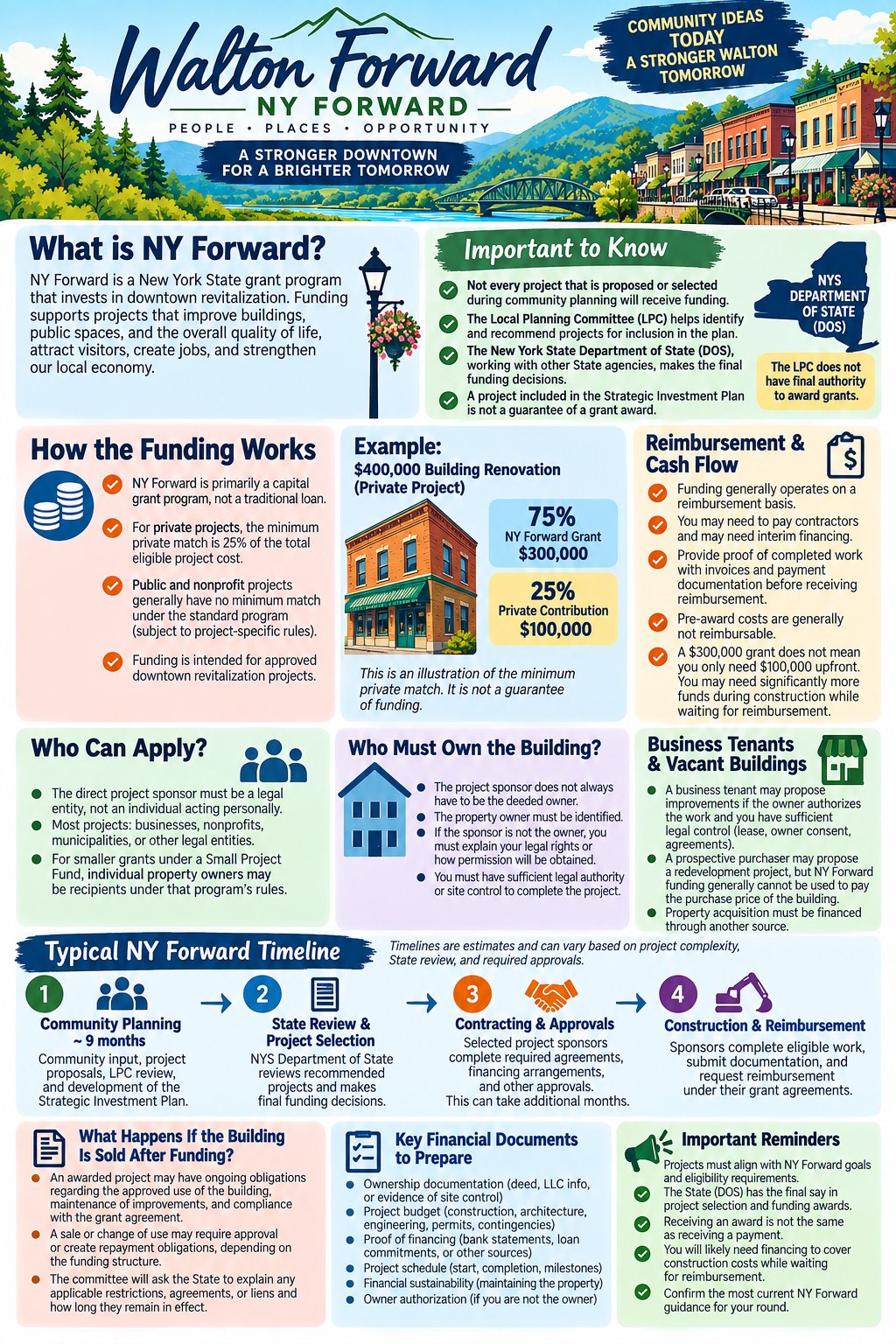
NY Forward is primarily a capital grant program, not a traditional loan. Private projects carry a minimum private match of 25% of total eligible project cost. Public and nonprofit projects generally have no minimum match under the standard program, subject to project-specific rules.
Example — $400,000 private building renovation
This is an illustration of the minimum private match. It is not a guarantee of funding.
Cash flow
Reimbursement — plan ahead
- Funding generally operates on a reimbursement basis — you may need to pay contractors first and may need interim financing.
- Proof of completed work, with invoices and payment documentation, is required before reimbursement.
- Pre-award costs are generally not reimbursable.
Eligibility
Who can apply?
The direct project sponsor must be a legal entity, not an individual acting personally. Most projects are sponsored by businesses, nonprofits, municipalities, or other legal entities.
For smaller grants under a Small Project Fund, individual property owners may be recipients under that program's rules.
Eligibility
Who must own the building?
- The sponsor does not always have to be the deeded owner.
- The property owner must be identified.
- If the sponsor is not the owner, explain your legal rights and how permission will be obtained — you must have sufficient legal authority or site control.
Common cases
Tenants & vacant buildings
A business tenant may propose improvements if the owner authorizes the work and the sponsor demonstrates sufficient legal control (lease, owner consent, or agreements).
A prospective purchaser may propose a redevelopment, but NY Forward funding generally cannot pay the purchase price — acquisition must be financed through another source.
What to expect
Typical timeline
- Community planning (~9 months): community input, project proposals, LPC review, and the Strategic Investment Plan.
- State review & project selection: the Department of State reviews and decides.
- Contracting & approvals: agreements, financing, and approvals — this can take additional months.
- Construction & reimbursement: complete eligible work, submit documentation, and request reimbursement.
Estimates only — timelines can vary.
Long-term
If the building is sold after funding?
Funded projects carry ongoing obligations around approved use, maintenance, and compliance. A sale or change of use may require approval or create repayment obligations. The committee will ask the State to explain the applicable restrictions, agreements, or liens and how long they last.
Get ready
Key financial documents to prepare
- Ownership documentation (deed, LLC info, or evidence of site control)
- Project budget (construction, architecture, engineering, permits, contingencies)
- Proof of financing (bank statements, commitments, or other sources)
- Project schedule (start, completion, milestones)
- Financial sustainability
- Owner authorization, if you are not the owner
Important reminders
- Projects must align with NY Forward goals and eligibility.
- The State — not the LPC — has the final say on awards.
- Receiving an award is not the same as receiving a payment.
- You will likely need financing to cover construction costs while waiting for reimbursement.
- Confirm the most current NY Forward guidance for your round.
See what winning applications look like
Research on every NY Forward award — the winners, the patterns they share, and what it means for Walton as residents weigh project ideas.
Read the NY Forward winners researchFunding
How Projects Get Funded
1. Project grants
NY Forward awards fund a slate of projects. Sponsors can be the village, a nonprofit, or a private owner. Public projects require no match, nonprofit-sponsored projects have no state minimum match, and private projects carry a minimum 25% match. All funding is reimbursement-based: the work is paid for first, then repaid.
2. Small Project Fund
Communities typically set aside part of the award (often around $300,000) as a local fund for smaller building and business projects — façades, storefronts, fit-outs, upper-story housing. In communities running one, grants are commonly $25,000–$100,000 per project, covering up to 75% of eligible costs with the owner matching the rest; each community's fund sets its own final terms.
3. Planning your financing
Because funding is reimbursement-based, sponsors usually arrange their own financing to carry a project, and a match can be assembled from more than one source. The best next step is to bring your project to a meeting.
Get ready
Open Call for Projects
Walton has not won NY Forward yet. When Walton wins, an Open Call for Projects will invite anyone — businesses, nonprofits, property owners, and residents — to propose projects for downtown.
Ideas posted now on the Idea Wall's NY Forward board become the raw material for that call — the strongest proposals start as community ideas today. Share your idea on the Idea Wall